English
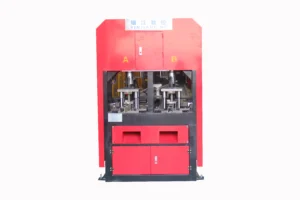
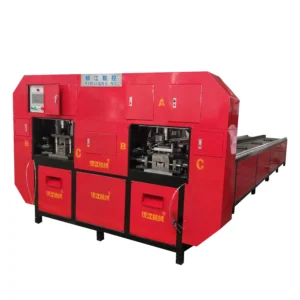
A three-sided H beam punching machine is designed for manufacturers that need to process repeated holes on different sides of H-sections efficiently.
Traditional H-beam processing may require repeated measuring, repositioning and clamping when holes are required on the web and flanges. For batch production, these repeated operations can increase processing time and operator workload.
A fully automatic three-sided punching system combines hydraulic punching with automatic feeding and positioning, allowing multiple punching operations to be organized within a more continuous production process. YINJIANG’s current H-section machine is specifically designed around three-sided processing, automatic feeding and positioning, and customized tooling for different H-beam specifications.
Below are six important advantages of this machine configuration.
Table of Contents
1. Three-Sided Punching Reduces Repositioning
One of the main advantages of a three-sided H beam punching machine is the ability to process different sides of an H-section within one machine system.
When using conventional equipment, the operator may need to process one side first, reposition the workpiece and then process another side.
For long and heavy structural profiles, repeated repositioning takes time and increases material handling.
A three-sided punching configuration can reduce these repeated operations by arranging punching stations around the workpiece.
This is particularly useful when holes are required on both flanges and the web.
YINJIANG’s H-section machine is designed specifically for three-sided processing and simultaneous production operations, which is one of the core differences between this machine and a simpler single-station punching system.
Why does this matter?
For repetitive parts, every additional handling operation becomes part of the total cycle time.
Reducing workpiece repositioning can help simplify the production sequence:
Loading → Positioning → Multi-Side Punching → Feeding → Next Hole Position
rather than repeatedly removing and turning the material.
2. Automatic Feeding Improves Batch Production
Manual measurement becomes increasingly inefficient when one H-beam contains many holes at different positions.
An automatic feeding system moves the workpiece according to the programmed processing sequence.
Instead of measuring every hole manually, the operator can set the required positions and allow the feeding system to move the material through the punching stations.
This is particularly useful for:
- Repeated hole spacing
- Long H-sections
- Multiple holes on one workpiece
- Medium and large production batches
- Standardized structural components
Automatic feeding does not mean that operators are unnecessary. Operators are still responsible for material preparation, machine monitoring, tooling inspection and finished-part quality.
However, it can significantly reduce repetitive measuring and positioning work.
YINJIANG’s current three-sided H-section machine includes automatic feeding and positioning as part of the machine design.
3. Accurate Positioning for Repeated Hole Patterns
Hole position is important in structural steel fabrication because components often need to align with other parts during assembly.
A manual process depends heavily on repeated measurement and operator positioning.
An automatic positioning system can improve repeatability when the same hole pattern is processed across multiple workpieces.
Important factors affecting punching consistency include:
- Servo feeding
- Workpiece clamping
- Material straightness
- Punching die condition
- Machine structure
- Positioning program
- Correct material dimensions
Servo systems are commonly used in industrial automation where controlled position and motion are required; Siemens, for example, describes modern servo drive systems as supporting position and motion-control applications.
For batch production, the goal is not simply to punch one accurate hole.
The goal is to reproduce the required hole pattern consistently across many components.
4. Hydraulic Punching Provides Stable Processing Force
The punching section of the machine uses hydraulic force to drive the punching process.
Hydraulic systems are widely used in industrial machinery because cylinders can provide controlled linear force for demanding machine applications. Bosch Rexroth, for example, supplies industrial hydraulic cylinders specifically for heavy-duty operating conditions.
For H-section processing, the required punching force depends on factors such as:
- Material type
- Material thickness
- Hole diameter
- Hole shape
- Die clearance
- Number of punching stations
This is why machine configuration should be based on the customer’s actual workpiece rather than selecting equipment only according to a general model name.
A suitable hydraulic punching system combined with the correct tooling provides a practical solution for repetitive hole processing in structural profiles.
5. Customized Dies for Different H-Beam Requirements
Different customers rarely process exactly the same H-section.
Differences may include:
- Beam dimensions
- Flange width
- Web height
- Material thickness
- Hole diameter
- Hole spacing
- Hole shape
- Hole position
For this reason, tooling is an important part of a punching machine project.
YINJIANG’s three-sided H-section punching machine can be configured with customized molds and machine arrangements according to different H-beam specifications.
Customers should therefore provide their workpiece drawings before the final machine configuration is confirmed.
A drawing allows the manufacturer to evaluate:
- Required punching positions
- Number of punching stations
- Punching force
- Die design
- Feeding distance
- Machine dimensions
- Material support requirements
This is especially important when several different H-beam specifications will be processed on the same production line.
6. Better Workflow for Structural Steel Production
H-sections are widely used as structural steel members, and standardized dimensions and hole locations are important during fabrication and connection preparation. AISC maintains dimensional references for rolled structural sections and technical resources covering structural steel detailing and connections.
For a factory producing repeated structural components, punching is only one step in the complete workflow.
A typical process may include:
Material preparation → Feeding → Positioning → Punching → Cutting or transfer → Inspection
If punching requires repeated manual repositioning, this section of the workflow can become a bottleneck.
A three-sided automatic punching machine is designed to make the punching stage more continuous.
This can be valuable for manufacturers producing:
- Structural steel components
- Prefabricated steel parts
- Construction frames
- Equipment structures
- Repetitive H-section assemblies
The actual production benefit depends on workpiece design and production volume, so drawings and production requirements should always be evaluated before selecting the final machine configuration. Structural steel manufacturers can also reference standardized rolled-section dimensions through the AISC structural steel dimensioning resources.
Three-Sided H Beam Punching vs Conventional Punching
A conventional single-side punching machine can be suitable when the workpiece only requires simple holes on one surface.
However, production becomes more complicated when holes are needed on several surfaces.
With conventional processing, the workflow may become:
Punch first side → Remove material → Rotate or reposition → Align again → Punch second side → Reposition → Punch third side
A three-sided machine reduces the need for this repeated handling.
For large batches, the difference becomes increasingly important because small amounts of handling time are repeated across every workpiece.
A three-sided system is more suitable when:
- Several sides need punching
- Hole patterns repeat across many workpieces
- H-sections are long or difficult to reposition
- Production quantities are medium or high
- Automatic feeding is required
- Labor-intensive positioning needs to be reduced
A simpler machine may still be sufficient when:
- Only one side requires punching
- Production quantity is very small
- Hole patterns rarely repeat
- Workpieces are easy to handle manually
The correct machine should match the actual production requirement rather than simply choosing the highest level of automation.
Why Is Automatic Positioning Important for Long H-Beams?
The longer the workpiece becomes, the more time manual measurement and repositioning can require.
For example, if an H-section contains multiple hole groups distributed along several meters of material, operators must repeatedly confirm distances and positions.
An automatic feeding system allows the machine to move the beam according to the programmed dimensions.
This helps create a repeatable processing sequence and reduces dependence on repeated manual measurement.
Material support is also important for long profiles because the workpiece should remain stable during feeding and punching.
The complete solution therefore includes more than the punching cylinder itself.
It also involves:
- Feeding
- Support
- Clamping
- Positioning
- Punching
- Control
These systems must work together.
Three-Sided H Beam Punching Machine vs Laser Processing
Punching and laser processing serve different production requirements.
Punching is often well suited to standardized holes and repetitive batch production.
Laser processing provides greater flexibility when:
- Hole shapes change frequently
- Complex contours are required
- New designs are introduced frequently
- Dedicated punching dies are not economical
For repetitive H-section holes, however, a punching machine can provide a straightforward production process once the correct dies and machine configuration are prepared.
The decision should therefore be based on:
- Product drawing
- Production quantity
- Hole complexity
- Material dimensions
- Frequency of design changes
- Required production speed
There is no single processing method that is best for every factory. For more information about selecting equipment, read our H beam punching machine guide.
What Information Should You Provide Before Ordering?
Before requesting a quotation for a three-sided H beam punching machine, prepare the following information:
- H-beam specification
- Material type
- Material thickness
- Workpiece length
- Hole diameter
- Hole shape
- Hole spacing
- Hole position on web and flanges
- Product drawings
- Daily production quantity
Photos of existing workpieces are also helpful.
With this information, the machine manufacturer can evaluate the required punching stations, tooling and feeding configuration. You can also explore our complete range of automatic punching machines for different metal profiles.
Conclusion
A three-sided H beam punching machine is designed to improve the efficiency of repetitive H-section hole processing.
Its main advantages include:
- Three-sided processing
- Reduced workpiece repositioning
- Automatic feeding
- Repeatable hole positioning
- Hydraulic punching force
- Customized tooling for different H-section specifications
For structural steel manufacturers processing repeated hole patterns in medium or large batches, combining automatic feeding, positioning and multi-side punching can simplify the production workflow.
YINJIANG provides fully automatic three-sided punching equipment for H-sections, with customized molds and machine configurations available according to different workpiece specifications.
Send us your H-beam dimensions, material thickness, hole size, hole positions and product drawing, or contact our engineering team for a suitable machine configuration.
FAQ
What is a three-sided H beam punching machine?
A three-sided H beam punching machine is designed to process holes on multiple sides of an H-section using dedicated punching stations, with automatic feeding and positioning available for repetitive production.
Can it punch the web and flanges of an H-beam?
The machine is designed for three-sided H-section punching. The exact punching positions and station configuration should be confirmed according to the customer’s H-beam drawing and hole requirements.
Does the machine use hydraulic punching?
Yes. The punching process can use hydraulic cylinders to provide the required punching force, while automatic feeding and positioning handle workpiece movement.
Can the punching dies be customized?
Yes. Your current product page states that customized molds and machine configurations are available according to different H-beam specifications.
What information is required for a quotation?
The most useful information includes H-beam size, material thickness, workpiece length, hole diameter, hole spacing, hole positions, production quantity and product drawings.