English
Table of Contents
Introduction
The advantages of an automatic tube punching machine become especially clear when a factory needs to process repeated holes across medium or large production batches.
Traditional drilling and manual punching often require workers to measure the tube, mark each hole position, move the material repeatedly, and check the finished workpiece. These steps take time and may lead to inconsistent hole spacing or lower production efficiency. Factories that still rely on manual measuring and repeated repositioning may also face several common production problems.
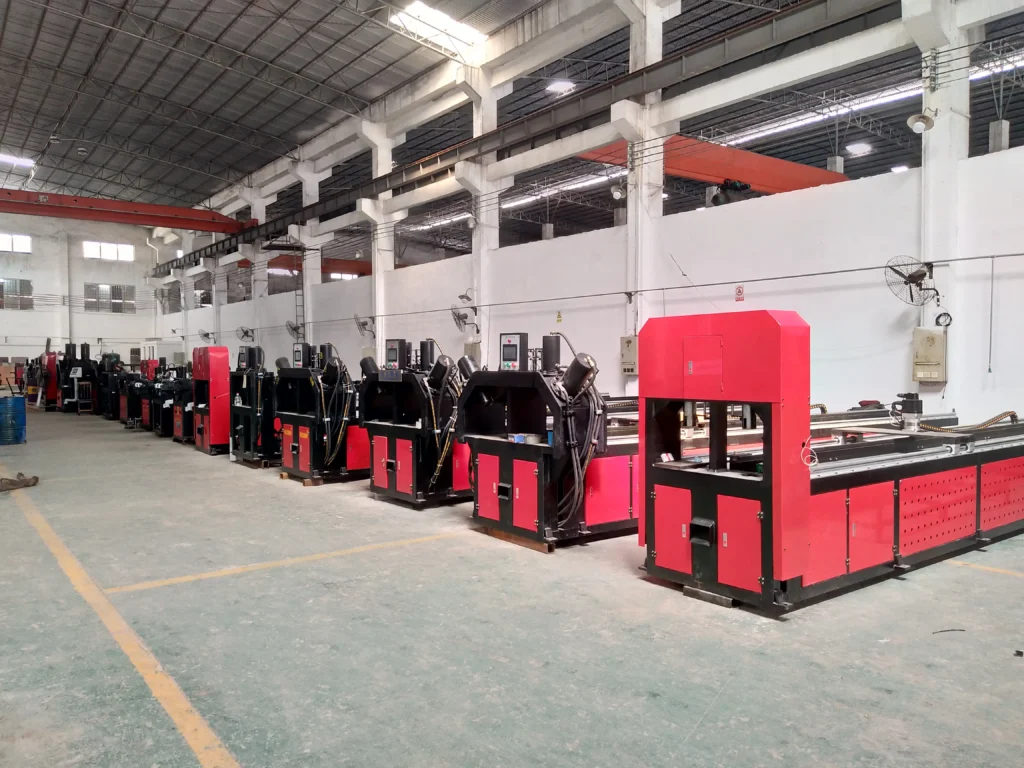
An automatic tube punching machine combines material feeding, programmed positioning, hydraulic punching, and customized tooling in one production process. Depending on the application, it can also be equipped with multiple punching stations and an optional fixed-length cutting system.
Below are seven practical advantages that this equipment can bring to tube and profile processing.
1. Faster Batch Production
One of the main advantages is faster production when the same hole pattern must be repeated on many workpieces.
After the processing parameters are entered into the control system, the machine can automatically feed the material to each required position and complete the punching operation. Workers do not need to measure and mark every hole manually.
This makes the machine suitable for products such as:
- Guardrail components
- Solar mounting brackets
- Furniture tubes
- Shelving and rack profiles
- Steel frame components
- Aluminum window and door profiles
The actual production speed depends on the material, wall thickness, hole shape, punching distance, feeding length, and machine configuration.
2. Consistent Hole Positioning
Consistent hole spacing is important when punched parts must be assembled with other components.
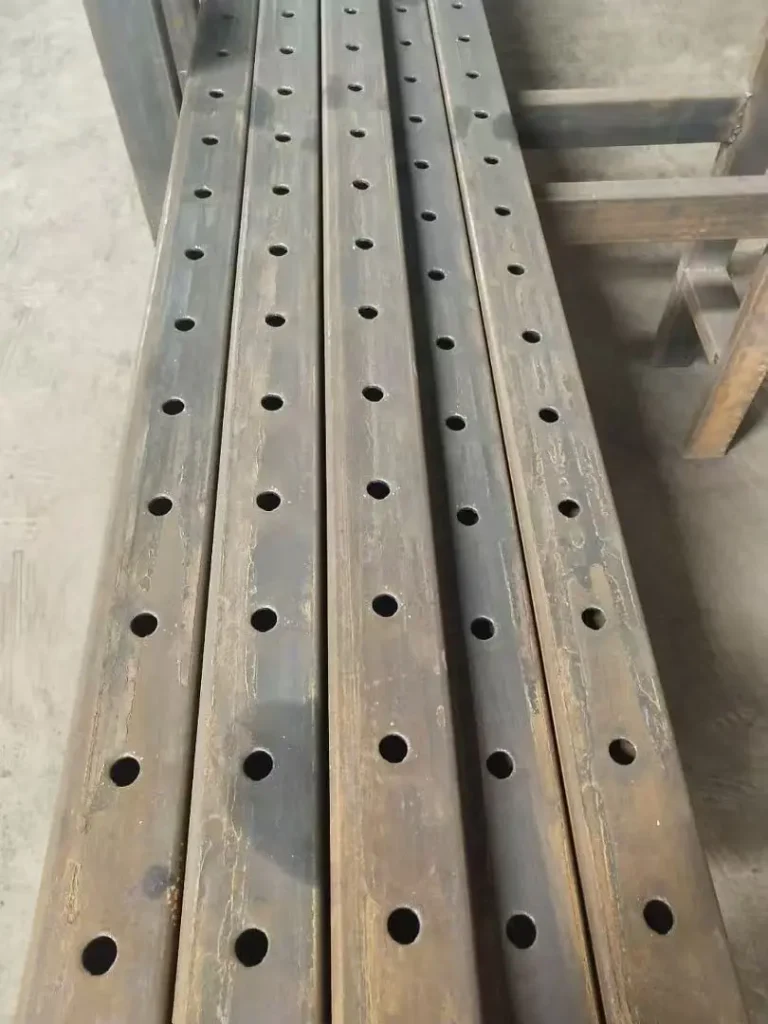
Manual measurement can be affected by operator experience, repeated handling, or positioning errors. An automatic feeding system uses programmed movement to control the distance between holes.
This helps improve consistency across a production batch and reduces the need for repeated inspection or correction. It is especially useful when several holes, slots, or patterns must be processed at fixed intervals.
For applications requiring higher positioning accuracy, the machine can be configured with a servo feeding system according to the workpiece and production requirements.
3. Less Manual Measurement and Repositioning
Manual processing often requires workers to move the tube several times, particularly when holes are needed on different positions or surfaces.
An automatic tube punching machine can reduce these repeated operations by combining feeding and punching in one workflow. Depending on the design, multiple punching stations can be installed to process different sides or hole patterns.
Reducing manual repositioning can help:
- Shorten the processing cycle
- Reduce handling between production steps
- Improve hole-position consistency
- Make batch production easier to manage
The final machine layout should be designed according to the tube shape, hole direction, and required processing sequence.
4. Lower Labor Requirements
Automatic feeding and programmed positioning reduce the number of manual steps required during production.
The operator mainly loads the material, selects or enters the processing program, monitors the machine, and collects the finished workpieces. This can reduce dependence on workers who perform repeated measuring, marking, and drilling.
The purpose is not simply to replace workers. It allows employees to spend less time on repetitive operations and more time on machine monitoring, quality checking, material preparation, and production management. Automated equipment should still be operated with proper machine guarding, operating procedures, and maintenance controls.
For factories facing labor shortages or increasing labor costs, automation can provide a more stable production method.
5. Flexible Punching Die Customization
Different products require different hole shapes, dimensions, and layouts. For this reason, the punching die is an important part of the machine solution.
Customized dies can be designed for:
- Round holes
- Square holes
- Rectangular holes
- Slots
- Notches
- Special hole patterns
The die configuration depends on the material, wall thickness, hole size, hole distance, and required production capacity.
Before manufacturing the machine, the supplier should review the customer’s drawings and sample requirements. This helps determine the punching force, die structure, feeding system, number of stations, and other technical details.
6. Automatic Feeding and Optional Cutting
In many production lines, punching is only one part of the complete process. The material may also need to be cut to a fixed length after the holes are completed.
An automatic tube punching machine can be equipped with an optional cutting system, depending on the material and finished-product requirements. This allows feeding, positioning, punching, and cutting to be completed in a connected workflow.
An integrated system can help reduce material transfers between separate machines. However, the cutting method must be selected carefully according to the profile shape, wall thickness, cut quality, and production speed.
Customers should provide both punching and cutting requirements when requesting a machine solution.
7. Suitable for Different Tubes and Profiles
Automatic punching equipment can be customized for different metal tubes and structural profiles, including:
- Round tubes
- Square tubes
- Rectangular tubes
- Aluminum profiles
- Angle steel
- Channel steel
- Flat steel
- Selected structural profiles
A single standard machine cannot process every material and profile effectively. The clamping method, feeding structure, punching force, die design, and supporting system must match the actual workpiece.
For this reason, machine configuration should always begin with a review of the customer’s product drawings and production process.
When Is an Automatic Tube Punching Machine Most Suitable?
An automatic tube punching machine is particularly suitable when:
- The same or similar hole patterns are repeated regularly
- Production quantities are medium or high
- Consistent hole spacing is important
- Manual measuring takes too much time
- The factory wants to reduce repeated material handling
- Customized dies can cover the required product range
For small quantities with frequently changing and highly complex shapes, a laser cutting machine may offer greater flexibility than a tube punching machine. The most suitable process depends on the material, hole design, production volume, required speed, and equipment budget.
Information Required for Machine Configuration
To recommend a suitable machine, the manufacturer normally needs the following information:
- Tube or profile drawing
- Material type
- Cross-sectional dimensions
- Wall thickness
- Hole shape and size
- Distance between holes
- Number of punching surfaces
- Required material length
- Target daily or hourly output
- Cutting requirements, if applicable
Providing complete information at the beginning helps the engineering team evaluate the punching force, feeding method, die structure, control system, and overall machine layout more accurately.
Conclusion
The main advantages of an automatic tube punching machine include faster batch production, consistent hole positioning, reduced manual measurement, lower labor requirements, customized tooling, automatic feeding, and flexible configuration for different tubes and profiles.
The best machine solution should be based on the customer’s actual workpiece rather than a general standard model. Material dimensions, wall thickness, hole layout, production quantity, and optional cutting requirements all affect the final configuration.
YINJIANG Machinery provides customized tube and profile punching solutions according to customer drawings and production requirements. Before manufacturing, our team can review the workpiece information, recommend a suitable configuration, and arrange machine testing based on the agreed processing needs. To receive a suitable machine configuration, contact our engineering team with your material dimensions, wall thickness, hole drawing, and production target.