English
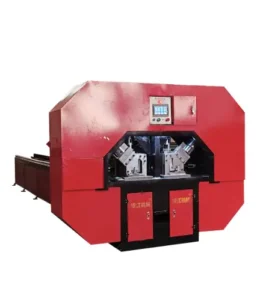
An angle steel punching machine for elevator bracket production is used to make repeated holes, slots, and cut-to-length parts on angle steel, flat steel, channels, tubes, and other metal profiles. For elevator component manufacturers, stable hole positions, efficient batch processing, and suitable mold design are important for maintaining consistent production.
Elevator systems contain many different metal brackets and connecting parts. Depending on the product design, manufacturers may need to process guide rail brackets, wall mounting brackets, support brackets, door system parts, frame components, and customized metal fittings. These parts may require round holes, long slots, multiple hole positions, side punching, or combined punching and cutting.
Choosing the correct punching machine can help reduce manual drilling work, improve production efficiency, and make repeated bracket processing more consistent.
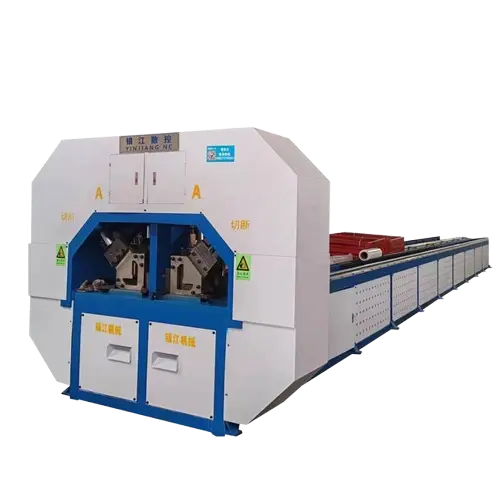
Table of Contents
What Is an Angle Steel Punching Machine for Elevator Brackets?
- Common Elevator Parts That Require Punching
- Materials Used for Elevator Brackets
- Common Hole Types and Processing Requirements
- Punching Machine vs Manual Drilling
- How an Angle Steel Punching Machine Works
- How to Choose the Right Machine
- Punching and Cutting in One Production Line
- Information to Prepare Before Requesting a Quote
FAQ
Conclusion
What Is an Angle Steel Punching Machine for Elevator Brackets?
An angle steel punching machine is a metal processing machine designed to punch holes or slots in angle steel, flat steel, channel steel, profiles, and other metal parts. When configured for elevator bracket production, the machine is designed according to the bracket material, section size, thickness, hole shape, hole distance, and required production speed.
Many elevator brackets require repeated holes for bolts, installation, adjustment, and connection. When these parts are produced in batches, manual drilling may require significant labor and may result in inconsistent positioning. A punching machine uses dedicated molds and positioning systems to repeat the same hole pattern more efficiently.
Depending on the production requirement, the machine may include hydraulic punching units, servo feeding, CNC positioning, multiple punching stations, automatic cutting, material supports, and customized fixtures.
Common Elevator Parts That Require Punching
Elevator manufacturing involves many metal components. The exact products vary according to the elevator structure, installation method, load requirement, and customer drawings.
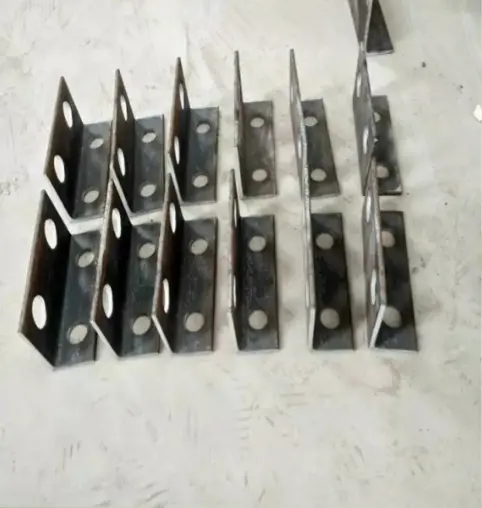
Common parts that may require punching include:
Guide rail mounting brackets
Wall fixing brackets
Angle steel support brackets
Elevator door frame components
Connecting plates
Flat steel mounting parts
Channel steel supports
Equipment frame components
Customized metal fittings
Some brackets only require one or two round holes. Other parts may require several holes at different distances, long slots for position adjustment, or holes on more than one side of the material.
Because elevator parts are often manufactured according to specific drawings, the punching machine should be selected based on the actual product rather than only the general product name.
Materials Used for Elevator Brackets
Elevator brackets and support components can be made from different metal materials. Common materials include carbon steel, galvanized steel, stainless steel, angle steel, flat steel, channel steel, square tube, rectangular tube, and other profiles.
Angle steel is commonly used for support and mounting parts because it provides a practical structure for fixing and connection. Flat steel and connecting plates may also be used for smaller brackets or reinforcing parts.
Before choosing a machine, the manufacturer should confirm:
Material type
Material thickness
Angle steel dimensions
Profile shape
Maximum material length
Required hole size
Required punching direction
Different materials and thicknesses require different punching forces. A thin profile with a small round hole does not require the same machine configuration as thick angle steel with a large slot.
The mold, hydraulic system, feeding mechanism, and clamping structure should therefore be designed according to the real material specifications.
Common Hole Types and Processing Requirements
Elevator brackets may require different hole types depending on their installation purpose. Common processing requirements include:
Round holes
Long holes
Oval slots
Square holes
Mounting holes
Adjustment slots
Multiple repeated holes
Holes on different sides
Customized hole patterns
Round holes are commonly used for bolts and fixed connection points. Long holes or oval slots may be used where the installer needs adjustment during assembly.
Some angle steel brackets need holes on only one side. Others may require punching on both sides of the angle steel. The machine structure and mold position must match the punching direction shown in the product drawing.
Hole distance is also important. For batch production, a feeding and positioning system can help control the distance between holes and reduce repeated manual measurement.
Punching Machine vs Manual Drilling
Manual drilling can be suitable for sample production, repair work, or small quantities. However, it may become inefficient when a factory needs to produce large numbers of identical elevator brackets.
Manual drilling usually involves marking, positioning, clamping, drilling, and moving the material for each hole. This requires more operator time and may lead to differences in hole position.
An angle steel punching machine is more suitable for repeated batch processing. Once the mold and positioning system are prepared, the machine can complete the same hole pattern many times.
Compared with manual drilling, a punching machine can provide several practical advantages:
Faster repeated hole processing
Reduced manual marking
More consistent hole positions
Lower operator workload
Suitable for batch production
Can be combined with automatic feeding
Can use customized molds for different hole shapes
The final hole quality still depends on the material, mold condition, machine setup, and correct operation. For this reason, the machine should be tested with the customer’s actual material before final delivery whenever possible.
How an Angle Steel Punching Machine Works
A typical angle steel punching machine uses hydraulic power to drive the punching mold through the material. The material is placed into a fixture or feeding system, positioned at the required location, and then punched.
A basic machine may require the operator to position the angle steel manually. This can be suitable for smaller production quantities or simple hole patterns.
For higher production requirements, the machine can include:
Automatic servo feeding
CNC length positioning
Multiple punching stations
Automatic material clamping
Automatic cutting
Touchscreen control
Program storage
Counting functions
Replaceable punching molds
With automatic feeding, the operator enters the hole distance or selects a stored program. The feeding system moves the material to each required position, and the punching unit completes the holes according to the programmed sequence.
The correct automation level should be chosen according to daily production quantity, product variety, and available budget.
How to Choose the Right Machine
Choosing the correct angle steel punching machine for elevator bracket production requires more than comparing machine power or price. The machine must match the actual material and product drawing.
The first step is to confirm the main products that will be processed. The manufacturer should identify whether the machine will be used for angle steel, flat steel, channel steel, tubes, plates, or several different materials.
The following information affects machine selection:
Material type and grade
Material thickness
Profile dimensions
Maximum material length
Hole shape and size
Distance between holes
Number of holes per part
Punching direction
Required cutting length
Daily production quantity
Required automation level
Factory voltage
If the factory produces only one standard bracket, a dedicated machine may provide efficient and stable production.
If the factory produces many different bracket models, the machine may need replaceable molds, adjustable fixtures, CNC positioning, and stored programs. However, one machine cannot process every possible material and bracket without limitations. The main product range should be confirmed before the machine design is finalized.
Punching and Cutting in One Production Line
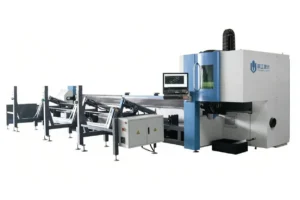
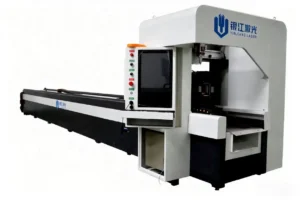
Some elevator bracket manufacturers need both hole punching and fixed-length cutting. In this situation, a combined punching and cutting machine can reduce separate production steps.
A typical process may include:
Loading the angle steel or profile
Automatic feeding
Positioning the material
Punching the required holes
Moving to the next position
Cutting the finished part to length
Collecting the completed bracket
Combining punching and cutting can reduce material handling and improve production flow. It may also help factories reduce the number of separate machines and operators required for one product.
However, a combined machine should be designed carefully. The cutting method, punching sequence, material support, finished-part discharge, and control program all need to match the product.
For high-volume production, an automatic punching and cutting line may be appropriate. For smaller quantities or frequent product changes, a simpler semi-automatic system may offer better flexibility.
Information to Prepare Before Requesting a Quote
Before requesting a quotation, it is important to provide complete product information. Only providing the words “elevator bracket” or “angle steel” is usually not enough because different brackets can have very different dimensions and hole patterns.
Prepare the following information:
Product drawing
Sample photographs
Material type
Material thickness
Angle steel or profile dimensions
Hole shape
Hole diameter or slot dimensions
Distance between holes
Punching direction
Finished cutting length
Daily production quantity
Required automation level
Factory voltage
If possible, also provide a short video of the current production process. This can help the machine supplier understand whether the factory is currently drilling, punching manually, or using several separate machines.
Clear drawings and production information allow the supplier to recommend the correct hydraulic force, mold design, feeding system, cutting unit, and machine layout.
FAQ
Can the machine punch both sides of angle steel?
Yes, a machine can be designed to punch one side or both sides of angle steel. The exact structure depends on the punching positions, material dimensions, and product drawing.
Can it produce long holes for adjustable elevator brackets?
Yes. Long holes, oval slots, round holes, and other customized shapes can be processed with suitable punching molds. The hole dimensions and material thickness must be confirmed before mold design.
Can one machine process different angle steel sizes?
In some cases, one machine can process several sizes by changing molds or adjusting fixtures. If the size difference is large, different molds or another machine structure may be required.
Can the machine punch and cut the material automatically?
Yes. The production line can be customized with automatic feeding, punching, positioning, and cutting functions. The appropriate configuration depends on the product and production quantity.
Is a CNC punching machine necessary?
A CNC machine is useful when the factory produces different hole distances, multiple product models, or higher quantities. For simple products with fixed hole positions, a standard or semi-automatic machine may be sufficient.
What documents should be provided before ordering?
The most useful documents are product drawings, material specifications, hole dimensions, finished-part length, daily output requirements, and sample photographs.
Can the machine be tested before shipment?
The machine can normally be tested with suitable sample material before shipment. Customers should provide accurate material and product requirements so that the supplier can confirm the test conditions.
For another industrial application, read how tube punching machines are used for solar mounting bracket production.
You can also read our guide to choosing a tube punching machine for guardrail production.
Conclusion
An angle steel punching machine for elevator bracket production can help manufacturers process repeated holes, adjustment slots, and fixed-length metal parts more efficiently. It can be used for guide rail brackets, wall mounting brackets, support components, connecting plates, angle steel parts, and other customized elevator metal fittings.
The correct machine should be selected according to the material, thickness, profile size, hole pattern, punching direction, cutting length, daily output, and automation requirement.
A properly designed punching machine can reduce manual drilling, improve repeated processing consistency, and support more efficient batch production. Before confirming a machine, manufacturers should provide detailed drawings and production information so that the punching molds, feeding system, cutting unit, and control system can be matched to the actual elevator bracket products.
For a suitable punching or cutting solution, send your product drawings, material dimensions, thickness, hole requirements, and daily production quantity for evaluation.