English
Hydraulic punching machine vs CNC punching machine is a common comparison for manufacturers choosing equipment for metal tube and profile processing.
When manufacturers need to punch holes in metal tubes, profiles, angle steel or channel steel, two terms frequently appear during machine selection: hydraulic punching machine and CNC punching machine.
However, these two terms do not always describe completely different machines.
A punching machine may use a hydraulic system to generate punching force while also using a CNC or servo control system to automatically position the material.
Understanding the difference can help manufacturers select a machine according to their production volume, material size, hole pattern and automation requirements.
What Is a Hydraulic Punching Machine?
A hydraulic punching machine uses hydraulic pressure to drive the punching cylinder and push the punch through the workpiece. Industrial hydraulic systems use components such as pumps, valves and cylinders to control pressure, flow and mechanical movement.
The hydraulic system provides strong and stable punching force, making it suitable for processing materials such as:
- Round tubes
- Square tubes
- Rectangular tubes
- Channel steel
- Angle steel
- Flat steel
- Metal profiles
- Structural steel components
Hydraulic punching machines are widely used when manufacturers need reliable punching force for repetitive metal processing.
Depending on the machine configuration, material positioning may be manual, semi-automatic or fully automatic.
What Is a CNC Punching Machine?
A CNC punching machine uses a numerical control system to control material positioning, punching positions and production sequences.
Instead of manually measuring every hole position, the operator enters or loads the required processing parameters into the control system.
The machine can then automatically control the feeding distance and punching position.
For repetitive production, CNC control can significantly reduce manual measuring work and improve consistency between workpieces.
The Main Difference: Punching Force vs Control System
One of the most important points is that hydraulic and CNC describe different parts of the machine.
Hydraulic usually refers to the power system.
CNC refers to the control and positioning system. CNC systems use computerized numerical control to automate machine tools and execute programmed machining operations.
This means a machine can actually be both:
a hydraulic punching machine and a CNC punching machine.
For example, an automatic tube punching machine may use hydraulic cylinders for punching while using servo motors and CNC control for automatic feeding and positioning.
Therefore, manufacturers should not simply ask whether a machine is hydraulic or CNC.
A better question is:
How does the machine generate punching force, and how does it control material positioning?
Hydraulic vs CNC Punching Machine Comparison
| Feature | Hydraulic Punching Machine | CNC Punching Machine |
|---|---|---|
| Punching force | Hydraulic system | Depends on machine design |
| Material positioning | Manual or automatic | CNC controlled |
| Automation | Low to high | Usually medium to high |
| Repetitive hole patterns | Suitable | Very suitable |
| Operator involvement | Depends on configuration | Lower |
| Production consistency | Good | Higher for repetitive work |
| Customized hole positions | Possible | Easier to program |
| Batch production | Suitable | Highly suitable |
The actual machine configuration may combine both systems.
Which Machine Provides Better Accuracy?
Accuracy depends on more than the punching force system.
Important factors include:
- Servo feeding accuracy
- Material clamping
- Guide system
- Machine frame rigidity
- Punching die condition
- Control system
- Material straightness
A manually positioned hydraulic punching machine may be suitable for simple hole patterns.
However, when manufacturers need multiple holes at fixed distances over long tubes or profiles, an automatic CNC feeding system generally provides better repeatability.
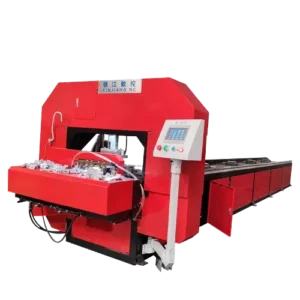
For example, YINJIANG automatic punching machines use servo-controlled feeding systems and hydraulic punching mechanisms to support repetitive processing of different metal profiles.
Which Machine Is Better for Batch Production?
For large-volume repetitive production, automation usually becomes more important than the basic punching method.
Consider a production line processing thousands of tubes with identical hole spacing.
Manual positioning requires operators to repeatedly:
- Measure the workpiece.
- Move the material.
- Align the punching position.
- Activate the punching cycle.
- Repeat the process.
An automatic CNC tube punching machine can automate much of this workflow.
After the processing parameters are set, the servo feeding system moves the material to the required position while the hydraulic system performs the punching operation.
This can reduce manual positioning time and improve consistency during batch production.
When Is a Hydraulic Punching Machine a Good Choice?
A hydraulic punching machine can be suitable when:
- High punching force is required.
- Materials are relatively thick.
- Hole shapes are standardized.
- Production quantities are stable.
- Punching dies can be used repeatedly.
- The manufacturer wants lower processing cost per piece.
Hydraulic punching is particularly effective when producing large quantities of standardized components.
Unlike laser cutting, punching requires dies, but once the correct tooling is prepared, production speed can be very high.
When Is a CNC Punching Machine a Better Choice?
A CNC-controlled punching machine is particularly useful when:
- Hole spacing varies.
- Multiple holes are required on one workpiece.
- Long tubes or profiles need automatic feeding.
- Production volume is high.
- Manual measuring needs to be reduced.
- Repeatable positioning is important.
It is especially useful for industries such as:
- Guardrail manufacturing
- Steel structure fabrication
- Furniture production
- Solar mounting systems
- Shelving systems
- Aluminum profile processing
- Construction material manufacturing
What About Punching and Cutting in One Machine?
Some manufacturers need both punching and cutting operations.
In this situation, a combined punching and cutting machine can perform multiple processes within the same production cycle.
For example, material can be automatically fed, positioned, punched and cut to the required length.
This reduces the need to move the workpiece between separate machines.
YINJIANG also manufactures integrated punching and cutting equipment for applications including aluminum profiles and photovoltaic components.
Hydraulic Punching Machine vs Laser Cutting Machine
Another common question is whether manufacturers should use punching or laser cutting.
Punching is usually more suitable for standardized products with repeated hole patterns.
Laser cutting offers greater flexibility when manufacturers frequently change:
- Hole shapes
- Cutting contours
- Product dimensions
- Production designs
Laser tube cutting does not require punching dies and allows manufacturers to switch between different patterns more easily.
For standardized high-volume production, punching can offer very high efficiency.
For flexible production with frequently changing designs, laser cutting may be more suitable.
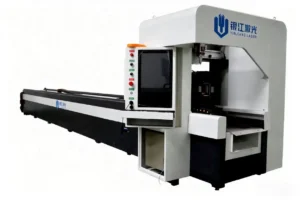
YINJIANG’s automatic laser tube cutting machines use automatic loading and feeding systems and support round, square and rectangular metal tubes.
What Information Should You Provide Before Choosing a Punching Machine?
Before requesting a machine quotation, manufacturers should prepare basic workpiece information.
This includes:
- Material type
- Tube or profile shape
- Material dimensions
- Wall thickness
- Hole diameter
- Hole shape
- Hole spacing
- Workpiece length
- Required daily production quantity
A product drawing is especially useful.
The machine manufacturer can use the drawing to determine the required punching force, number of cylinders, mold design, feeding method and machine configuration.
Can a Punching Machine Be Customized?
Yes.
Industrial punching machines are often configured according to the customer’s actual workpiece.
Customization may include:
- Punching dies
- Number of punching stations
- Hydraulic cylinder configuration
- Feeding length
- Material support system
- Automatic loading
- Automatic cutting
- Control program
For unusual profiles or complicated hole layouts, manufacturers should provide drawings or sample photos before the machine configuration is finalized.
Conclusion
The difference between a hydraulic punching machine and a CNC punching machine is not simply about choosing one technology over another.
Hydraulic refers mainly to how punching force is generated, while CNC refers to how the machine controls positioning and processing.
Modern automatic punching machines often combine both technologies.
A hydraulic system provides the punching force, while servo motors and CNC controls handle material feeding and positioning.
For manufacturers processing tubes, profiles, channel steel, angle steel and other metal components in batches, this combination can provide stable punching force, automatic positioning and repeatable production.
YINJIANG manufactures automatic punching machines and customized metal processing equipment for different material sizes, hole patterns and production requirements.
Send us your workpiece drawing, material dimensions, thickness and required production quantity, and our team can recommend a suitable machine configuration. contact our engineering team.
FAQ
Is a CNC punching machine hydraulic?
It can be. Many CNC punching machines use hydraulic systems to generate punching force while CNC and servo systems control feeding and positioning.
Is hydraulic punching faster than laser cutting?
For standardized repetitive holes, hydraulic punching can be very fast once the correct die is installed. Laser cutting is generally more flexible when hole shapes and product designs change frequently.
Can a hydraulic punching machine automatically feed tubes?
Yes. A hydraulic punching machine can be combined with servo feeding and CNC control to automatically position tubes during production.
What materials can an automatic punching machine process?
Depending on the machine configuration, automatic punching machines can process materials such as square tubes, seamless pipes, channel steel, angle steel, flat steel and other metal profiles.
Do I need a custom punching die?
Usually yes. The punching die should match the required hole size, hole shape, material and processing requirements.