English
Tube Punching Machine Applications in Saudi Arabia
Tube punching machine Saudi Arabia solutions are increasingly relevant for steel fabricators producing tubes, profiles, structural components and repetitive metal parts.
Saudi Arabia is expanding its manufacturing capabilities as part of its wider industrial development strategy.
Under Saudi Vision 2030 and the National Industrial Strategy, the Kingdom is working to strengthen local manufacturing, industrial competitiveness and production capabilities. Saudi Arabia is also developing machinery and equipment manufacturing as part of a broader industrial ecosystem.
For steel fabrication companies, this development creates a growing need for production equipment that can handle repeated processing efficiently.
One important process is punching holes in tubes, pipes and metal profiles.
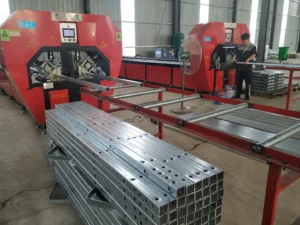
An automatic tube punching machine in Saudi Arabia can be used for repetitive hole processing where manufacturers need consistent spacing, automatic feeding and stable batch production.
Rather than looking at punching equipment only as a machine, it is more useful to understand where it fits into the complete fabrication process.
Table of Contents
1. Tube Punching Machine Saudi Arabia Applications in Steel Fabrication
For manufacturers evaluating a tube punching machine Saudi Arabia production solution, one of the main considerations is how repeated holes are produced efficiently and consistently.
These holes may be used for:
- Bolts
- Fasteners
- Structural connections
- Equipment installation
- Brackets
- Supports
- Assembly positioning
For a small number of components, workers may measure and drill holes manually.
The situation changes when a factory needs to produce hundreds or thousands of similar parts.
Repeated manual measuring can increase:
- Labor requirements
- Processing time
- Positioning variation
- Material handling
- Rework
This is where an automatic tube punching machine becomes useful.
A typical production sequence can be simplified to:
Loading → Automatic Feeding → Positioning → Punching → Cutting → Finished Part
For repetitive metal fabrication, the objective is not simply to make one hole quickly.
The real objective is to reproduce the same hole pattern consistently across a production batch.
2. Structural Steel Components
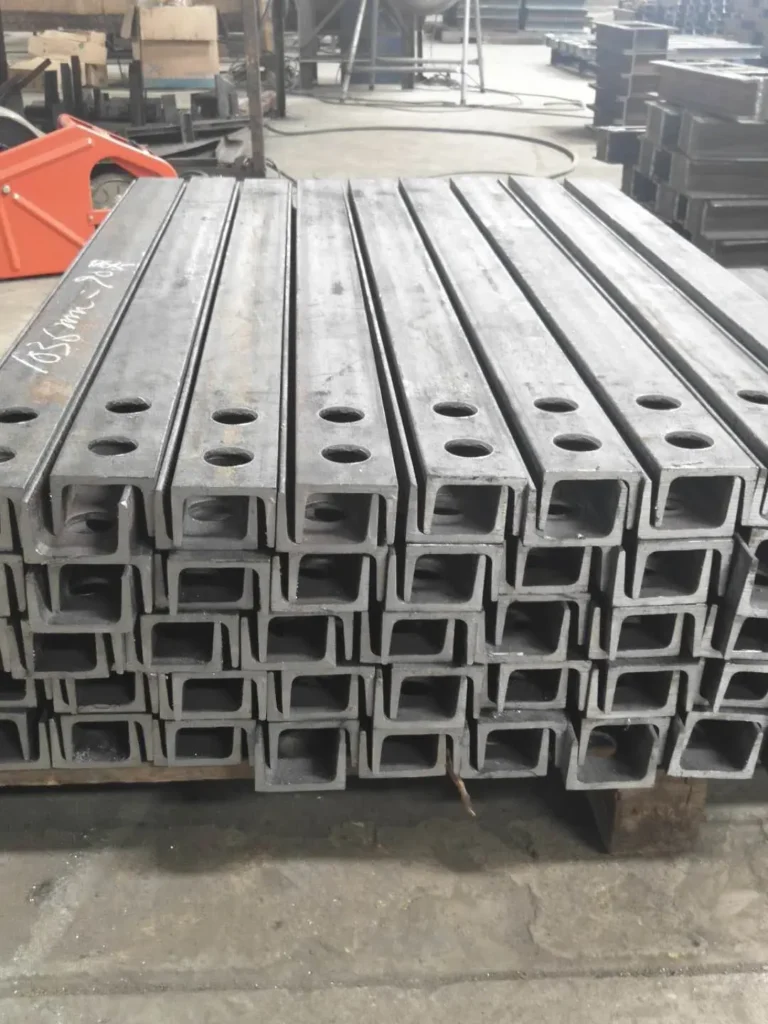
Structural steel fabrication is one of the important application areas for automatic punching equipment.
Factories may process:
- Square tubes
- Rectangular tubes
- Round pipes
- Channel steel
- Angle steel
- Flat bar
- H-sections
- Other metal profiles
Different structural components require different hole layouts.
For example, one product may require two holes every 300 mm, while another may require several holes at different positions along the material.
With automatic feeding, the workpiece can be moved according to programmed dimensions before each punching cycle.
This reduces the need for workers to manually measure every hole position.
For manufacturers producing repeated structural components, this can make the entire fabrication workflow easier to organize.
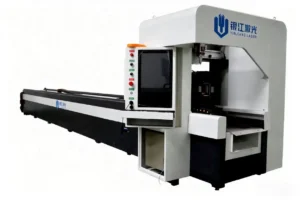
YINJIANG’s automatic punching equipment is designed for tubes and different metal profiles, with machine configuration available according to workpiece and production requirements.
3. Supports, Brackets and Connection Parts
Steel brackets and support components may look simple, but they are often produced in large quantities.
Typical parts can include:
- Equipment brackets
- Connection plates
- Steel supports
- Mounting components
- Frame components
- Construction fittings
If the hole pattern remains the same, punching can be more suitable for repetitive production than continuously measuring and drilling each component separately.
The production process becomes especially efficient when:
- Hole diameter is standardized
- Hole spacing repeats
- Material dimensions are stable
- Production quantity is high
- Cutting length is also repetitive
Customized punching dies can be prepared according to the required hole shape and dimensions.
This allows the machine configuration to be based on the customer’s actual finished product rather than forcing every factory to use one standard machine setup.
4. Solar Mounting and Energy-Related Components
Metal profiles are also widely used in mounting and support structures.
These components can require repeated holes for:
- Bolted connections
- Installation positions
- Structural adjustment
- Assembly between profiles
For standardized products, automatic punching can help reduce repeated manual positioning.
Saudi Arabia’s industrial strategy emphasizes the development of manufacturing capability and local value chains as part of the Kingdom’s wider economic transformation.
For manufacturers supplying energy, infrastructure or industrial projects, flexible production equipment can therefore become increasingly important.
The machine should still be configured according to the actual profile, thickness, hole size and production volume.
There is no single punching machine configuration that is suitable for every solar or structural component.
5. Fencing, Racking and Industrial Structures
Another common application is repetitive metal components used in:
- Industrial fencing
- Storage racks
- Warehouse systems
- Guard structures
- Equipment frames
- Steel support systems
These products often contain long tubes or profiles with regularly spaced holes.
Consider a production order requiring 1,000 identical steel profiles.
If every profile requires eight holes, the factory needs to complete:
8,000 punching positions
At this scale, even a small amount of repeated measuring time can become significant.
Automatic feeding allows the material to move through programmed positions instead of relying on workers to measure every hole manually.
This is one reason automatic punching becomes more valuable as production volume increases.
6. Why Automatic Feeding Matters
For more information about automated production, see the advantages of an automatic tube punching machine.
Accurate feeding is also important for maintaining consistent tube punching hole positioning.
Punching force is only one part of machine performance.
For repetitive production, the feeding system is equally important.
An automatic feeding system controls how the workpiece moves between punching positions.
If the required hole spacing is:
100 mm → 200 mm → 200 mm → 350 mm
the machine program can control the movement between each punching position.
This helps reduce repeated manual marking and measuring.
However, final processing consistency still depends on:
- Material straightness
- Correct clamping
- Feeding calibration
- Tooling condition
- Machine setup
- Correct production parameters
Automatic feeding therefore does not mean that operators are unnecessary.
Instead, it reduces repetitive positioning work and allows operators to focus more on material preparation, machine monitoring and quality inspection.
7. Punching and Cutting in One Production Line
Some factories require more than punching.
The workpiece may also need to be cut to a specified length after the holes are completed.
A conventional process may require:
Measure → Punch → Remove Material → Transfer → Measure Again → Cut
An integrated punching and cutting machine can simplify this to:
Automatic Feed → Punch → Continue Feeding → Cut → Finished Part
This is particularly useful for standardized products where:
- Hole layouts repeat
- Cutting lengths repeat
- Production quantities are relatively high
It can also reduce material movement between separate machines.
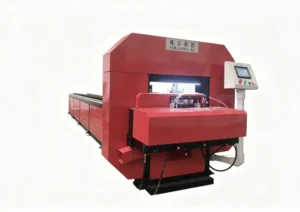
YINJIANG manufactures punching-and-cutting integrated equipment for several types of metal profiles and allows machine configuration to be customized according to production requirements.
8. Different Materials Require Different Machine Configurations
The term tube punching machine covers many different applications.
A machine for a small square tube should not automatically be assumed to be suitable for a heavy structural profile.
Machine configuration depends on factors such as:
- Material type
- Cross-section
- Wall thickness
- Hole diameter
- Hole shape
- Hole quantity
- Workpiece length
- Required production speed
For example:
Square and rectangular tubes
usually require reliable clamping and feeding to maintain the correct orientation.
Round pipes
may require different positioning and supporting methods.
Angle and channel profiles
have different cross-sectional shapes and therefore require suitable fixtures and dies.
H-sections
may require punching on the web and flanges, making a multi-side punching configuration more suitable.
This is why the customer’s actual product drawing is more useful than simply asking:
“Which punching machine should I buy?”
9. Why Customized Machinery Matters
Industrial production requirements can vary significantly between factories.
One manufacturer may produce:
50 × 50 mm square tubes with 12 mm holes.
Another may process larger structural profiles with several hole diameters.
A third factory may require:
Punching + automatic feeding + cutting + unloading
within one production line.
Using the same standard configuration for all three factories may not be practical.
For customized equipment, the machine can be evaluated according to:
- Workpiece dimensions
- Material thickness
- Required punching force
- Hole layout
- Die quantity
- Feeding length
- Cutting requirements
- Automation level
- Target production capacity
YINJIANG focuses on customized punching solutions and can evaluate machine configuration according to drawings and production requirements.
For Saudi steel fabricators processing specialized components, this can be especially useful when standard equipment does not match the actual production process.
10. Automation and Saudi Arabia’s Industrial Development
Saudi Arabia’s industrial development strategy places strong emphasis on improving manufacturing capability, increasing local content and developing more competitive industrial sectors. Saudi Arabia’s machinery and equipment sector.
The Saudi government’s industrial strategy describes a competitive and sustainable industrial sector as an important part of Vision 2030.
Invest Saudi also identifies machinery and equipment as part of the country’s expanding industrial ecosystem and reported more than 12,700 active factories across the Kingdom in 2025.
For metal fabricators, automation does not necessarily mean replacing every existing process.
It can begin with the operations that create the most repetitive work.
Tube and profile punching is a good example.
When production involves:
- Repeated hole spacing
- Long materials
- Multiple hole positions
- Large batches
- Repeated cutting lengths
automatic feeding and punching can help create a more continuous manufacturing process.
11. What Information Is Needed for a Production Solution?
If your factory is evaluating a tube punching machine in Saudi Arabia, providing detailed workpiece information can make the machine recommendation much more accurate.
Useful information includes:
- Material type
- Tube or profile dimensions
- Wall thickness
- Workpiece length
- Hole diameter
- Hole shape
- Hole positions
- Cutting length
- Daily production quantity
- Product drawings or sample photos
A drawing is particularly useful because it allows the machine manufacturer to understand the complete processing requirement.
For customized industrial equipment, machine selection should start from the finished product rather than from a machine model number.
Conclusion
Steel fabrication involves much more than simply punching a hole.
For repetitive production, manufacturers also need to consider:
- Material feeding
- Positioning
- Clamping
- Tooling
- Cutting
- Production consistency
- Automation
An automatic tube punching machine for Saudi Arabia can support the production of structural components, brackets, supports, industrial frames and other repetitive metal parts.
The correct solution depends on the actual material and finished product.
YINJIANG provides customized automatic punching and punching-and-cutting solutions for tubes, pipes and metal profiles.
If you are processing steel components in Saudi Arabia, send us your product drawing, material dimensions, thickness, hole requirements and production quantity.
Our engineering team can evaluate a suitable machine configuration according to your production requirements. Contact our engineering team.
FAQ
What is a tube punching machine used for in Saudi steel fabrication?
A tube punching machine is used to produce holes in tubes, pipes and metal profiles for structural connections, brackets, supports, frames and other fabricated components.
Can an automatic punching machine process different tube shapes?
Yes, depending on machine configuration. Equipment can be designed for square tubes, rectangular tubes, round pipes and different metal profiles.
Can punching and cutting be combined in one machine?
Yes. For repetitive products, an integrated machine can combine automatic feeding, punching and fixed-length cutting in one production workflow.
Is a hydraulic punching machine suitable for structural steel?
It depends on material dimensions, thickness, hole size and required punching force. The machine should be configured according to the actual workpiece.
Can the machine be customized for Saudi customers?
Machine configuration can be customized according to the customer’s material, drawings, hole layout, cutting requirements and required production capacity.
What information should I send for a machine recommendation?
Send material dimensions, wall thickness, hole diameter, hole positions, workpiece length, production quantity and preferably a product drawing.